Pairing a Long/Short SMA with an Opportunity Zone Fund
OBBBA Permanent Rules · Tax-Efficient Redeployment · Loss Harvesting Offset
Illustrative Case Study: $2 Million Portfolio | Q1 2027 Investment
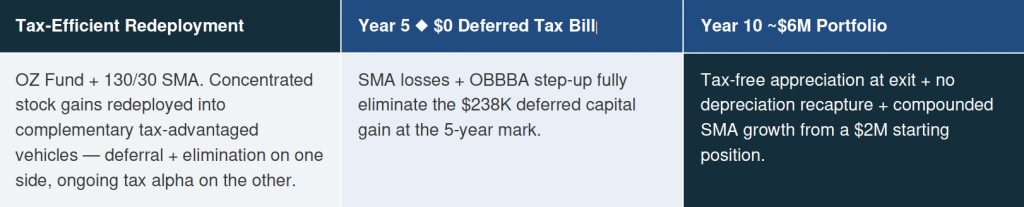
This case study models a $2 million portfolio split equally between a Qualified Opportunity Fund (QOF) and a 130/30 Long/Short SMA — redeploying proceeds from a concentrated stock position in Q1 2027 under the permanent Opportunity Zone rules established by the One Big Beautiful Bill Act. The combination produces three compounding tax advantages: deferral and elimination of the capital gain, ongoing tax alpha from the SMA, and SMA loss harvesting that — at the 4.41% annual tax alpha documented for 130/30 strategies — fully eliminates the deferred capital gain at the 5-year mark. The result: a $238,000 deferred tax bill reduced to $0, a $2M portfolio that grows to approximately $6M by Year 10 — with tax-free appreciation and no depreciation recapture on exit.
Three Outcomes at a Glance
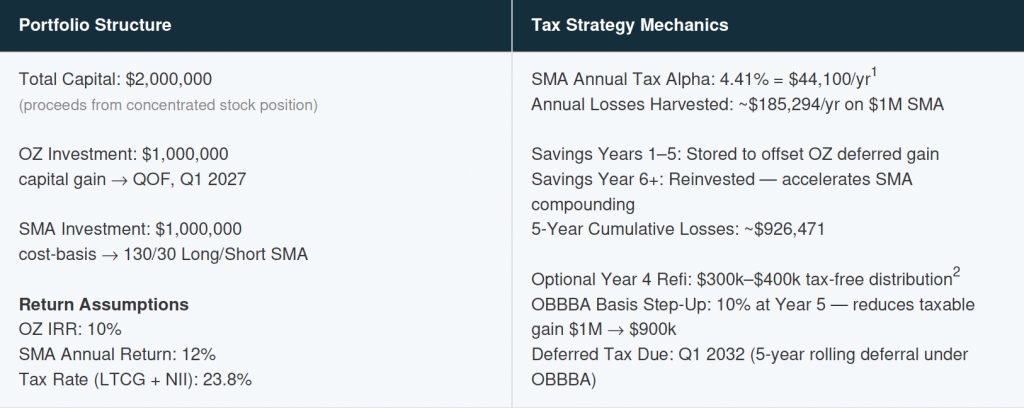
Portfolio Structure & Assumptions
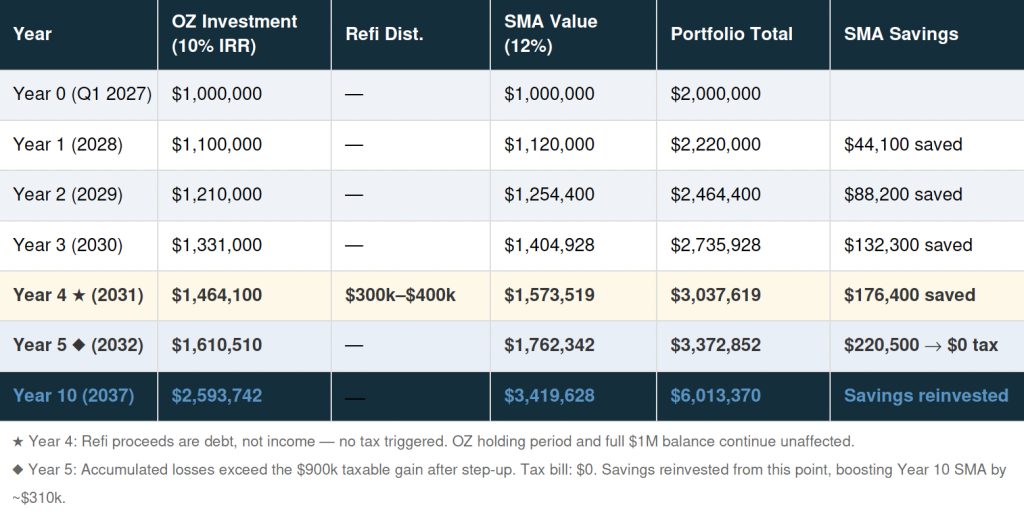
Projected Growth
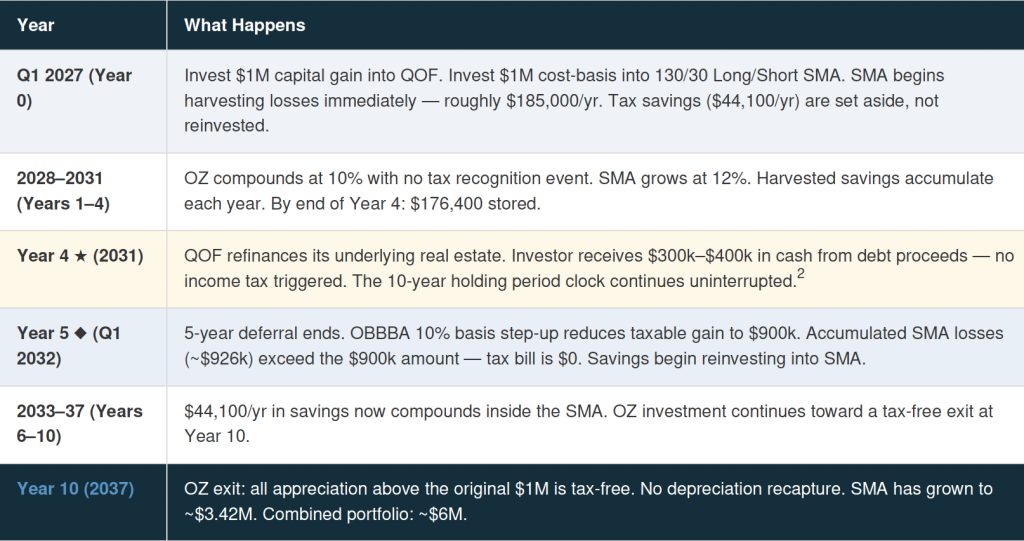
The 130/30 SMA harvests losses on both the long and short book. At the 4.41% annual tax alpha documented for these strategies1, that generates roughly $185,000/yr in losses on a $1M portfolio — equivalent to $44,100/yr in tax savings stored against the future OZ gain bill.
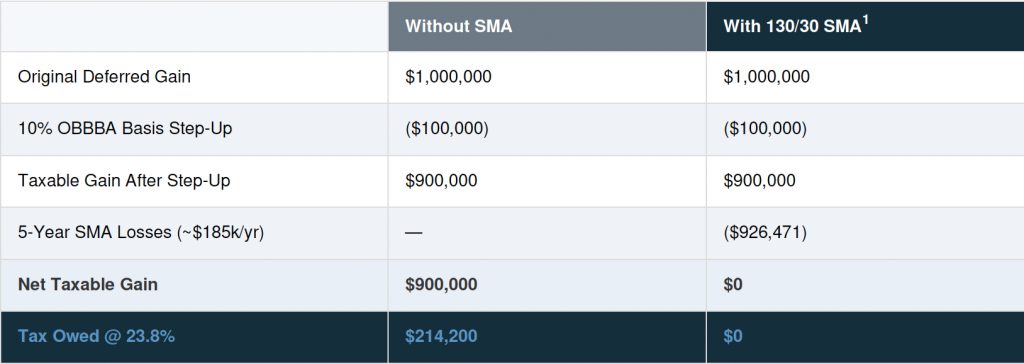
Year 5 (Q1 2032): Why the Tax Bill Reaches Zero
Three mechanisms stack at Year 5 to eliminate the deferred gain:
Tax Timeline
Strategic Takeaway
5-Year Rolling Deferral:
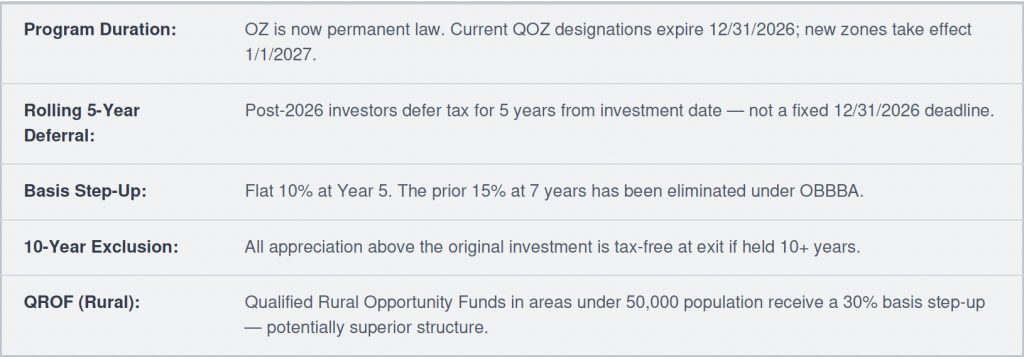
A 2027 investor gets the same 5-year runway early TCJA investors received in 2018 —versus only ~1 year under OZ 1.0 (2025). More time to accumulate losses and stage capital before the tax bill arrives.
Tax-Efficient Redeployment:
Rather than holding a concentrated position or paying tax to diversify, the investor redeploys gains into two complementary tax-advantaged vehicles. The OZ fund defers and ultimately eliminates the capital gain; the 130/30 SMA generates 4.41% annual tax alpha that offsets the remaining liability.
SMA Loss Harvesting Eliminates the Gain:
At the academic benchmark for 130/30 strategiesÅ, five years of harvested losses exceed the taxable gain after the OBBBA step-up. The investor pays $0 in deferred capital gains tax — and $220,500 in stored savings begins compounding inside the SMA from Year 6.
Year 10 Outcome:
~$6M gross portfolio with tax-free OZ appreciation at exit and no depreciation recapture. From a $2M starting position — $0 in deferred capital gains and $0 in depreciation recapture.
Appendix: OBBBA Program Changes Reference
1 Goldberg, Lisa R., Taotao Cai, and Ben Schneider. “A Guide to 130/30 Loss Harvesting.” Journal of Asset Management 25, no. 5 (2024): 445–459. The 4.41% figure is average pre-liquidation tax alpha for a cash-funded 130/30 portfolio, back-tested June 1995–June 2023. Actual results vary by manager, benchmark, and market conditions.
2 Refinancing proceeds are debt, not income, and do not trigger a recognition event under current QOF rules. However, distributions in excess of the investor’s basis in the QOF interest may be treated as a partial inclusion event. Confirm treatment with qualified tax counsel prior to refinancing.
Disclaimer: This document is for educational purposes only. Pinnacle Partners does not offer legal, investment, tax, or other professional advice. Tax rules reflect the One Big Beautiful Bill Act (P.L. 119-21) as signed July 4, 2025. Consult qualified tax advisors before taking action.